

Discover the seven questions every attraction operator should be able to answer – and download the free 15-minute Ride Inspection Readiness Checklist.
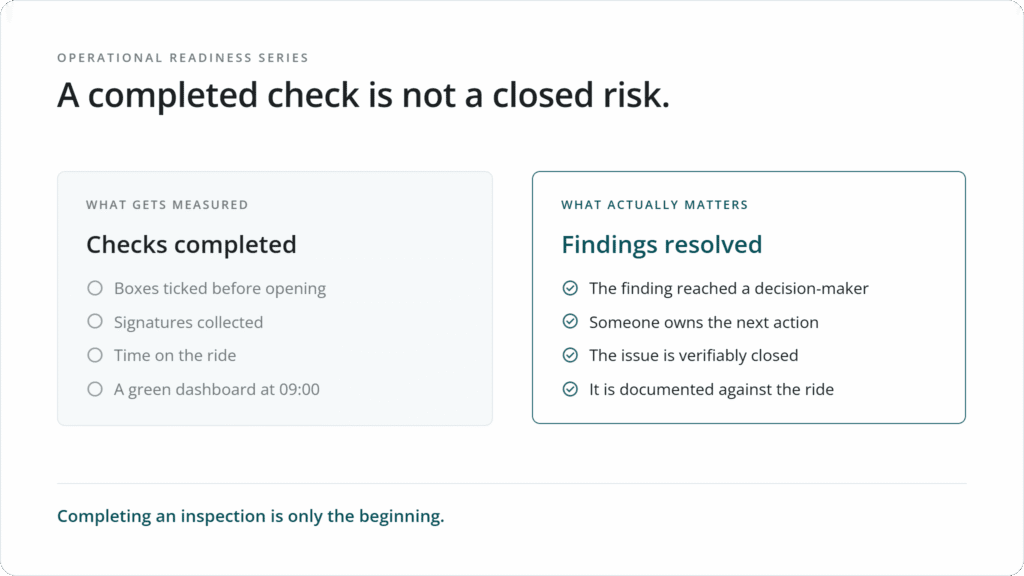
Completing the checklist is only the beginning. The real test is what happens when an inspection finds something that requires action.
Ride inspections are a basic requirement of safe attraction operations. Pre-opening checks, in-service checks, recurring inspections, preventive maintenance routines – most operators have a process for making sure these happen. Staff know what to inspect. Checklists exist. Records get completed.
The harder question is what happens next.
A worn component. An unusual noise. A missed check. A result that doesn’t stop operation immediately but still needs a closer look. This is where the difference between completing inspections and controlling the inspection process shows up. A completed checklist is not the same as a resolved issue.
Seven questions that show how controlled your process really is
1. Are checks specific to the ride? Generic routines are easy to standardize but easy to leave gaps in. A mature process ties checks to the specific ride, manufacturer requirements, operating conditions, and known safety-critical components — not a one-size-fits-all form.
2. Can supervisors see missed or incomplete checks immediately? A scheduled inspection that never happens is operationally different from a completed one. If spotting that difference depends on asking around or opening individual records, a missed routine can stay invisible longer than it should.
3. Can staff record context, not just a tick? The most useful inspection information often lives in the exceptions: a note on unusual wear, a photo, a measurement, an observation that isn’t yet a failure but deserves attention. A process that only captures pass/fail loses that context.
4. Do unusual findings automatically reach the right people? Recording a finding isn’t the same as communicating it. If getting it to the right supervisor or maintenance technician depends on a verbal handover, a separate email, or someone remembering later, context gets lost between inspection and action. This also includes having a clear process for deciding whether a ride can keep operating after a failed or flagged item — not leaving that call to whoever happens to be on shift.
5. Can a finding become an owned action with a clear path to closure? This is arguably the most important question. A finding without an owner is just recorded information. A controlled process moves it through: finding → assignment → maintenance action → documentation → closure — with a visible owner, a priority, and a record of what was done.
6. Can you reconstruct the history of an issue later? Can you answer what was checked, when, by whom, what was found, what action followed, and whether it’s happened before? That matters for audits, but it also supports better decisions day to day — inspection data becomes part of the ride’s operational history rather than a stack of isolated records.
7. Can management spot patterns across rides, teams, and locations? Inspection maturity isn’t only about the individual check. It’s whether recurring issues, repeated failures, missed-check patterns, and downtime causes are visible enough to act on — and whether they inform where preventive maintenance needs adjusting.
The inspection is complete. The issue may not be.
Say a pre-opening inspection finds unexpected wear on a component. The inspector logs the observation and submits the checklist. The inspection is now complete.
But several operational questions have only just opened up:
-
- Who needs to see the finding?
-
- Who owns the next action, and by when?
-
- Can maintenance see the original inspection context?
-
- Can a supervisor tell whether the issue is still open?
-
- Will the resolution get documented against the ride?
-
- Would anyone notice if this same issue has come up before?
A strong inspection process has to answer more than “was the check completed?” It also has to answer: what was found, what happened next, and can we show the loop was closed?
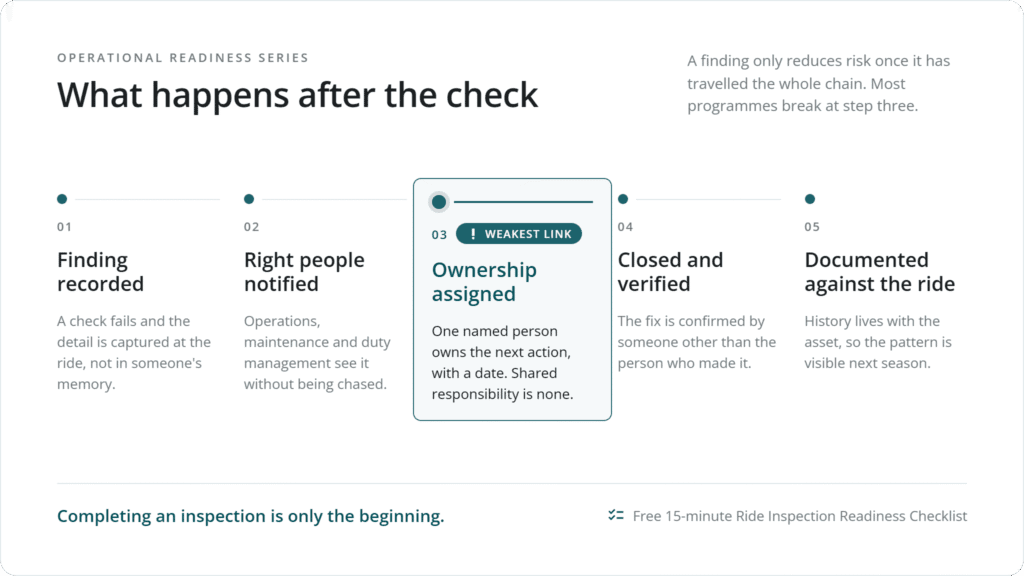
A mature process connects the full workflow
The strongest inspection processes treat the checklist as one step in a connected workflow, not an isolated task:
- Schedule the check – recurring and pre-opening inspections are planned per ride.
- Complete the inspection – the right person runs a ride-specific routine.
- Capture observations – notes, photos, and readings are recorded alongside the result.
- Flag missed or failed items – exceptions surface immediately to supervisors.
- Assign follow-up – findings become owned actions with clear due dates.
- Document the action – repairs and outcomes are recorded against the ride.
- Review patterns – recurring issues inform smarter maintenance planning.
The value of an inspection doesn’t end when someone submits the checklist. In most operations, that’s exactly when the process is supposed to begin.
How ready is your current process?
It’s easy to assume an established inspection routine is also a controlled one. In practice, the gaps usually sit between teams, tools, and handovers: between the person who finds the issue and the supervisor who needs to see it, between the inspection record and the maintenance action, between the completed repair and the ride’s history, between daily inspection data and the decisions management makes from it.
That’s the gap the Ride Inspection Readiness Checklist is built to help you find.
Download the free Ride Inspection Readiness Checklist
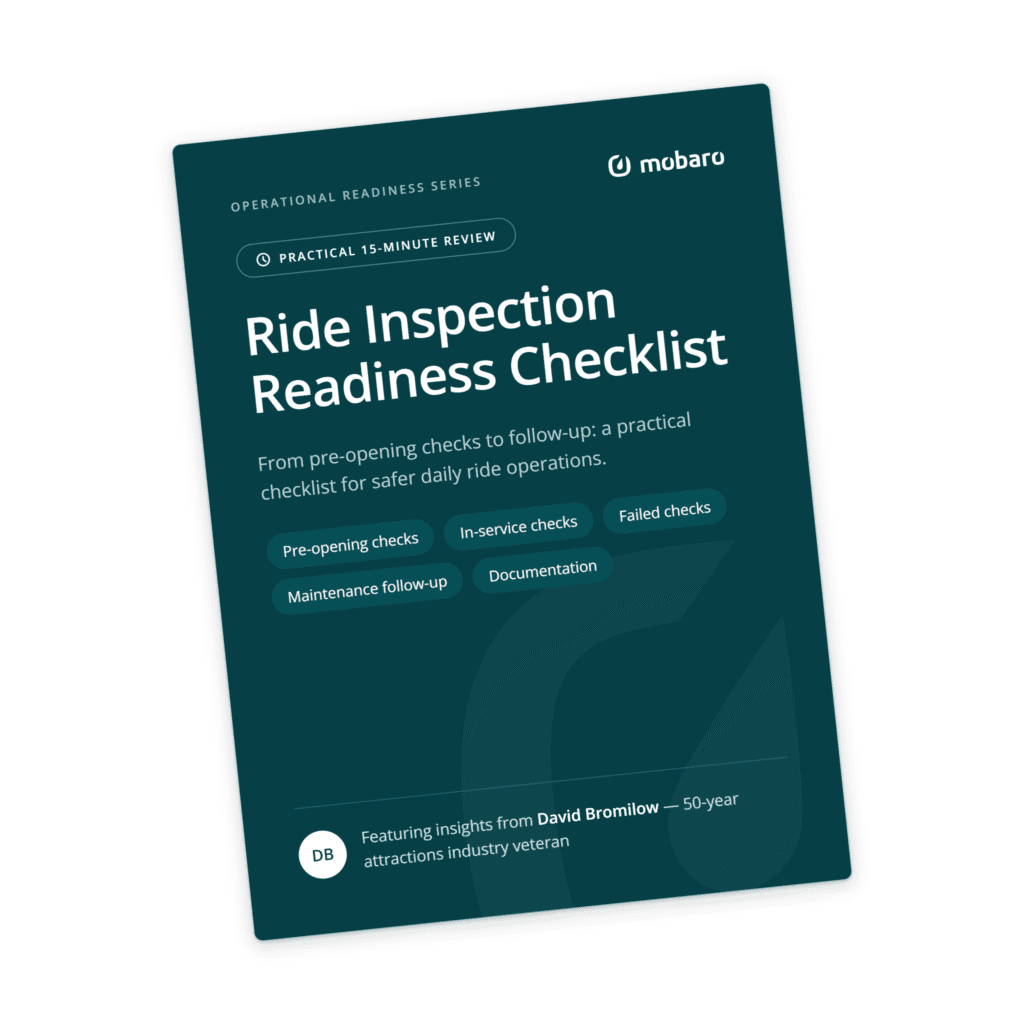
A 15-minute review of how your operation handles ride inspections — from pre-opening checks through follow-up, documentation, and management visibility.
The 16-page workbook covers six areas:
- Pre-opening inspection readiness
- In-service and recurring checks
- Failed checks, observations, and exceptions
- Maintenance follow-up
- Ride history and documentation
- Management visibility and continuous improvement
Inside, you’ll find a 36-point readiness review, a scoring model across four maturity levels, guidance on where to improve first, a 30-day action plan, and insights from attractions industry veteran David Bromilow.
From inspection completion to structured follow-up
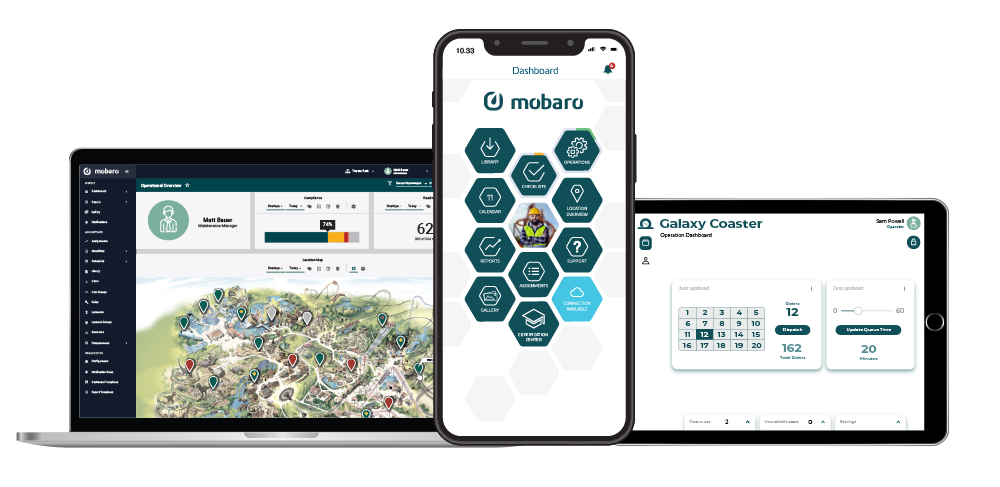
Mobaro helps attractions manage ride inspections as part of a connected daily operations workflow. Teams can schedule and complete digital ride checklists, manage daily, recurring, and pre-opening checks, make missed, failed, or incomplete checks visible, capture notes, photos, and observations, turn findings into assignments, document maintenance follow-up, review ride history and operational records, and give supervisors visibility across rides, teams, and locations.
See how Mobaro supports ride inspections
















 EN
EN  ES
ES