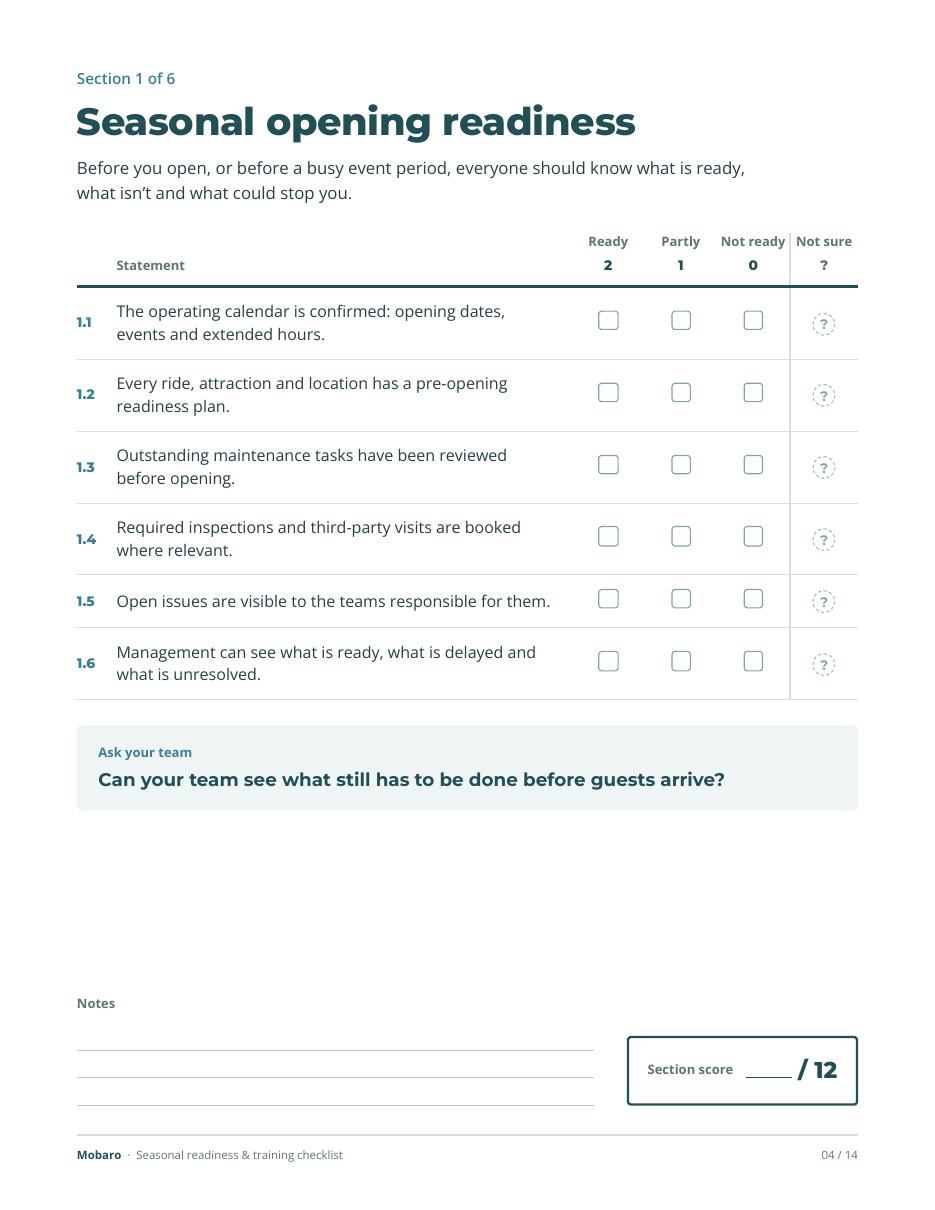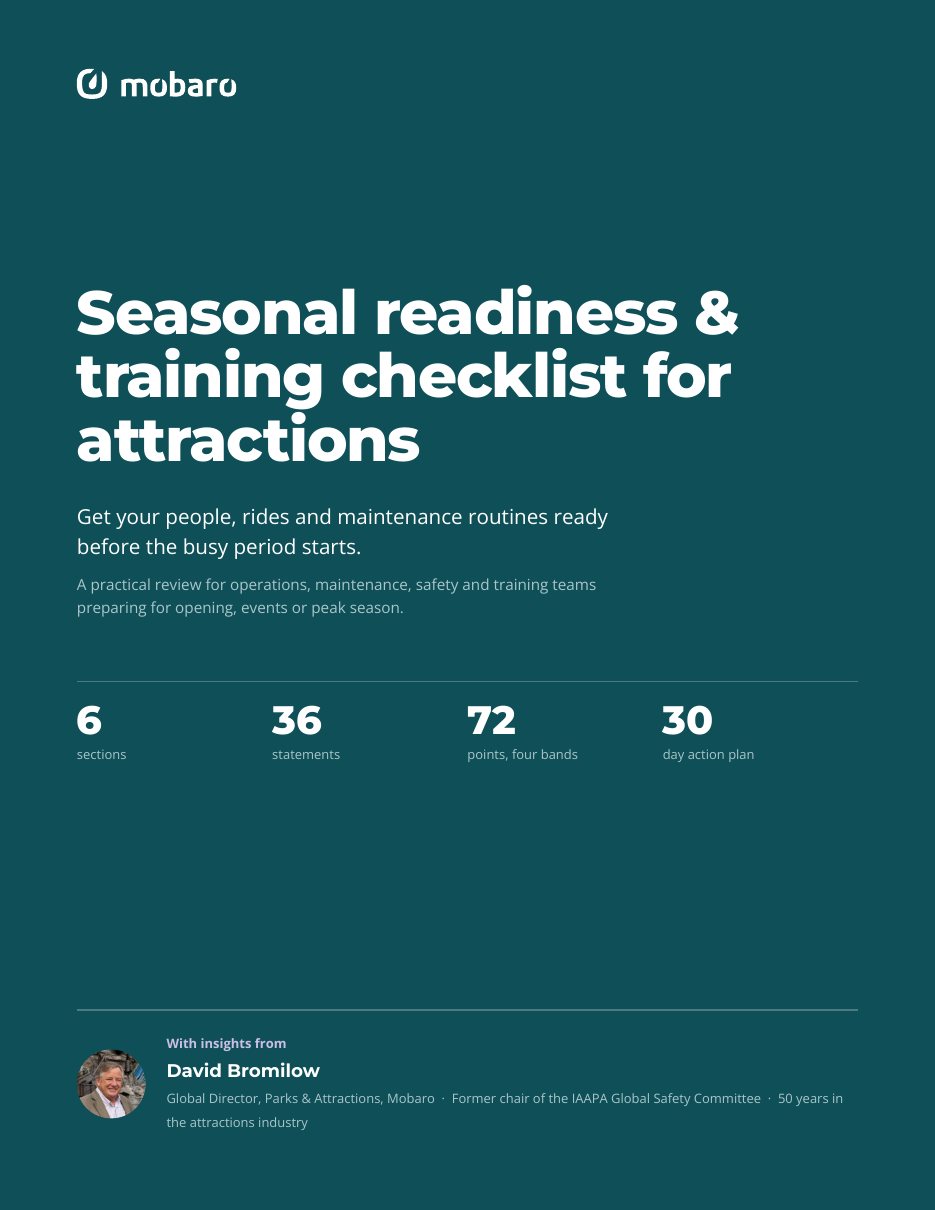


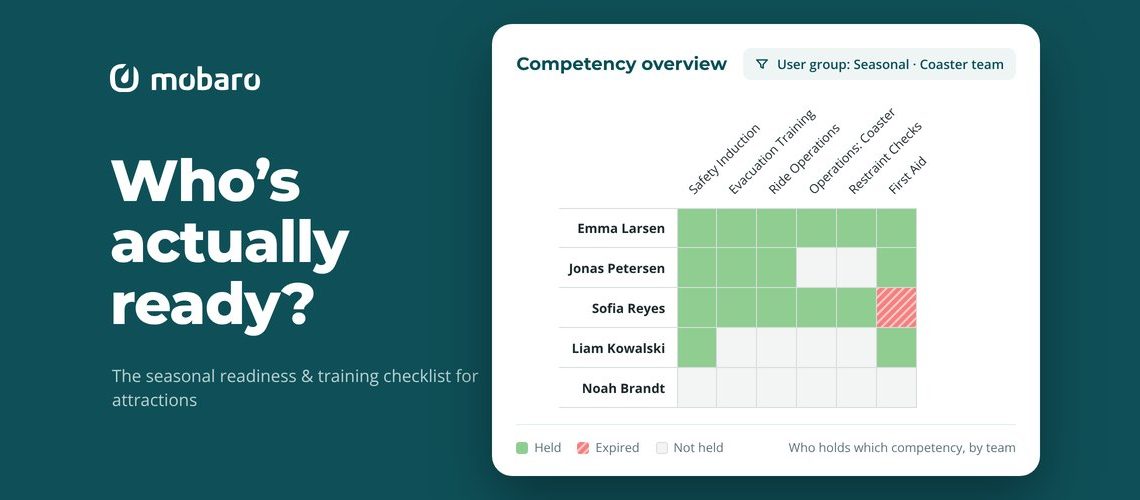
Download the free Seasonal Readiness and Training Checklist and find the gaps that could cause problems once operations get busy.
The schedule is filled
New team members have attended training.
Procedures have been shared.
On paper, your attraction may look ready for the season.
But readiness isn’t determined by whether training was scheduled or a document was distributed. The real test starts when the gates open, guest numbers rise, and teams have to make the right call under pressure.
Do employees understand what’s expected of them?
Can supervisors confirm that required training has actually been completed?
Are procedures current, accessible, and applied the same way across every shift?
And does everyone know what to do when something falls outside the normal routine?
These questions reveal whether a team is genuinely ready – or just looks ready on a planning sheet.
No form required. Use the checklist with your operations, safety, maintenance, and training teams.
Peak season exposes the gaps that quieter periods hide
Seasonal operations put a particular kind of pressure on attractions.
Teams grow quickly. Experienced employees take on new responsibilities. New starters have to absorb a lot of information in a short time. Routines that work fine with a small permanent team suddenly have to hold up across more people, more shifts, and higher guest volumes.
At the same time, there’s less room to stop and correct misunderstandings.
A procedure may have been explained in training, but interpreted differently on the floor.
A team member may know how to complete a task, but not when to escalate a concern.
A supervisor may assume training is done without having a clear overview of who’s actually been assessed and approved.
None of this necessarily shows up during planning. It shows up once the operation is already under pressure.
That’s why seasonal readiness needs to be verified, not assumed.
Seven questions to ask before operations get busy
1. Are roles and responsibilities clear?
Every team member should understand not just their own tasks, but where their responsibility ends and when someone else needs to step in.
This matters even more when temporary and permanent staff work side by side.
When responsibilities are unclear, issues get missed because everyone assumes someone else has it covered.
Ask:
- Does each role have clearly defined responsibilities?
- Do employees know which decisions they can make on their own?
- Is it clear when a supervisor, safety lead, or maintenance team needs to get involved?
- Are handovers between departments defined?
Clarity cuts down on hesitation, duplication, and gaps in follow-up.
2. Has training been understood – not just attended?
Attendance isn’t the same as competence.
A completed training session proves the information was delivered. It doesn’t prove the employee understood it, can apply it, or will recognise when a situation calls for escalation.
A stronger process includes some form of verification:
- observation
- practical demonstration
- supervisor sign-off
- knowledge check
- role-specific assessment
This matters most for safety-critical tasks and procedures.
The question isn’t:
Has the employee completed training?
It’s:
Can the employee perform the task correctly and consistently on a real shift?
3. Are your procedures current and easy to access?
Procedures often change between seasons.
Equipment may have been updated. Responsibilities may have shifted. Lessons from last season may have led to new routines. Manufacturer guidance or local requirements may have changed too.
But updating a document is only the first step.
The current version also has to reach the people who need it.
Check whether:
- outdated versions have been removed
- employees can access the right procedure during their shift
- changes have been clearly communicated
- affected employees have acknowledged or been trained on the update
- supervisors can confirm which version is currently in use
When multiple versions are circulating, even well-trained employees can end up following the wrong one.
4. Can managers see who’s ready?
Readiness shouldn’t depend on spreadsheets, memory, or asking individual supervisors.
Managers need a reliable overview of:
- who’s completed required training
- who’s been assessed as competent
- which qualifications are due to expire
- who’s approved for specific roles or attractions
- where training or documentation is still missing
Without that visibility, gaps often only surface once an employee is already scheduled for a task they’re not fully prepared for.
A clear readiness overview lets managers act before the shift starts, not after.
5. Do employees know how to report and escalate concerns?
Most procedures describe how normal work should go.
But operations don’t always follow the expected pattern.
An employee may spot damaged equipment, an unusual reading, a missed check, or something they haven’t seen before.
At that point, they need to know:
- what to report
- how to document it
- who receives it
- whether operations can continue
- who owns the next action
- how they’ll hear the outcome
Employees shouldn’t have to improvise the escalation process after an issue has already happened.
6. Are routines consistent across teams and shifts?
One team may follow a procedure exactly. Another may rely on experience and informal workarounds.
One supervisor may document every deviation. Another may resolve issues verbally and move on.
These differences are easy to miss, especially when the end result looks the same.
But inconsistent execution makes it harder to:
- confirm required work was actually completed
- keep reliable documentation
- spot patterns
- train new employees
- investigate incidents
- improve the operation over time
Good seasonal readiness means critical routines get performed the same way, regardless of who’s on shift.
7. Have you tested readiness under realistic pressure?
Training usually happens in a controlled environment.
Peak operations don’t.
High guest volumes, staff absence, changing weather, technical issues, and competing priorities all affect how well procedures hold up.
Before the busiest period starts, consider testing scenarios such as:
- an attraction can’t open as planned
- a required check hasn’t been completed
- an employee reports an unexpected issue
- a trained team member is absent
- responsibility transfers between shifts
- multiple departments need to coordinate a response
A short tabletop exercise or walkthrough can expose unclear responsibilities and missing procedures before they affect guests or employees.
Readiness needs a system behind it, not just a training event
Seasonal preparation often gets treated as a sequence of steps:
- Recruit employees
- Deliver training
- Publish schedules
- Open for the season
Genuine readiness needs something more connected than that.
Training needs to link to:
- roles and permissions
- operating procedures
- who’s actually been signed off, and on what
- daily checks
- how issues get reported
- who owns follow-up, and whether it’s closed
- what managers can actually see
When these pieces are disconnected, a manager can know that training happened without knowing whether the team is actually ready.
A more mature process makes that readiness visible — able to answer:
- Who’s trained?
- Who’s approved?
- Which procedures apply?
- What’s still incomplete?
- What issues have been reported?
- Who owns the next step?
- Has it been resolved?
That visibility matters more as teams grow and operations get busier.
A practical review for your team
The Seasonal Readiness and Training Checklist is built to help attraction operators review their preparation before and during the busiest parts of the season.
Use it to create a structured conversation across operations, safety, maintenance, HR, and training.
It can help you spot gaps in areas like:
- roles and responsibilities
- onboarding and training
- competency verification
- procedures and documentation
- communication and handovers
- issue reporting and escalation
- management oversight
- follow-up over time
It isn’t meant to replace your existing procedures or regulatory requirements.
It’s a practical way to check whether the systems around those procedures are strong enough to support consistent execution.
No registration. No form. Download the PDF and use it with your team.
Make seasonal readiness easier to manage
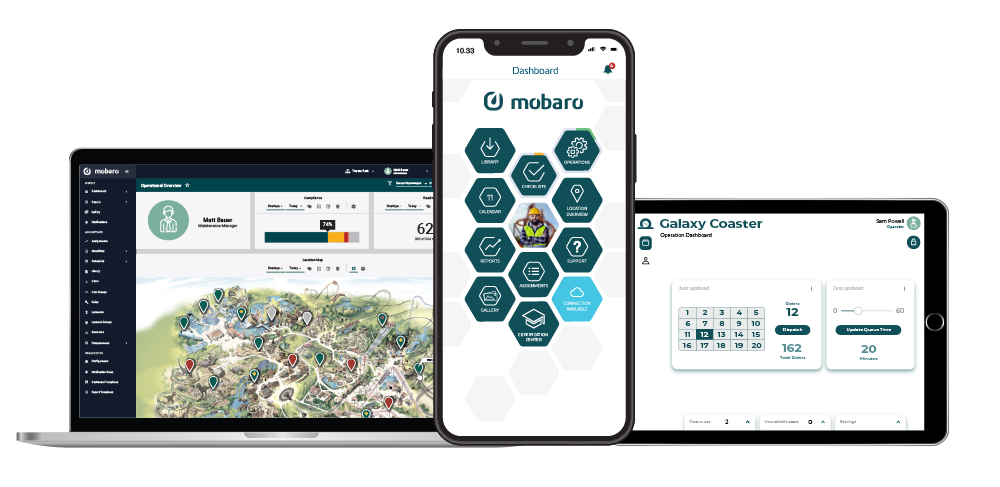
Mobaro brings training, competencies, procedures, checklists and operational follow-up together in one platform built for the attractions industry.
Give managers a clear view of who is ready, what is still outstanding and where action is needed – before small gaps become operational problems.
Acerca de Mobaro
Mobaro is an all-in-one, cloud-based platform built for safety, maintenance, and operations in the attractions industry.
It helps attractions replace disconnected processes with one structured system for checklists, inspections, assignments, competencies, documentation, and operational follow-up.