

Ride inspections are built around moments in time. A ride is assessed, documentation is reviewed, findings are recorded. But as computer vision and sensor-based monitoring technologies are being rolled out across the world’s leading attractions, operators are provided with immense amounts of performance data in real-time.
Continuous monitoring can create a technical history of how a ride behaves across thousands of operating cycles. That raises a new question for the attractions industry: What happens if an inspector gets access to richer data on how a ride has developed since the last inspection?
To explore this, we spoke with Ralph Pesgens, Head of Amusement & Leisure Division (Global) and Senior Vice President Buildings (APAC/ME/MED) at TÜV NORD, one of the leading inspection bodies serving the amusement industry.
From a snapshot to a technical history
“Traditional inspections and maintenance provide important assessments at specific moments,” Pesgens explains. “Continuous monitoring adds another dimension: quantitative data collected throughout operation.“
That distinction matters.
Parameters such as vibration, acceleration, loads, temperature and operating cycles can be recorded throughout operation. Instead of isolated measurements, operators can begin to see how a ride is changing over time.
“This creates a technical history rather than just individual snapshots,” Pesgens says.
For the operator, that history can provide earlier warning of developing maintenance needs. For the inspector, it can provide context that previously did not exist.
A vibration reading taken today may look perfectly acceptable. But if the same reading has been gradually changing across thousands of ride cycles, the history may tell a more interesting story.
The inspector doesn’t need more data. They need better evidence.
Modern rides and monitoring systems can generate enormous volumes of information. Asking an engineer or inspector to manually interpret all of it would simply create a new problem. This is where AI-supported analysis becomes relevant.
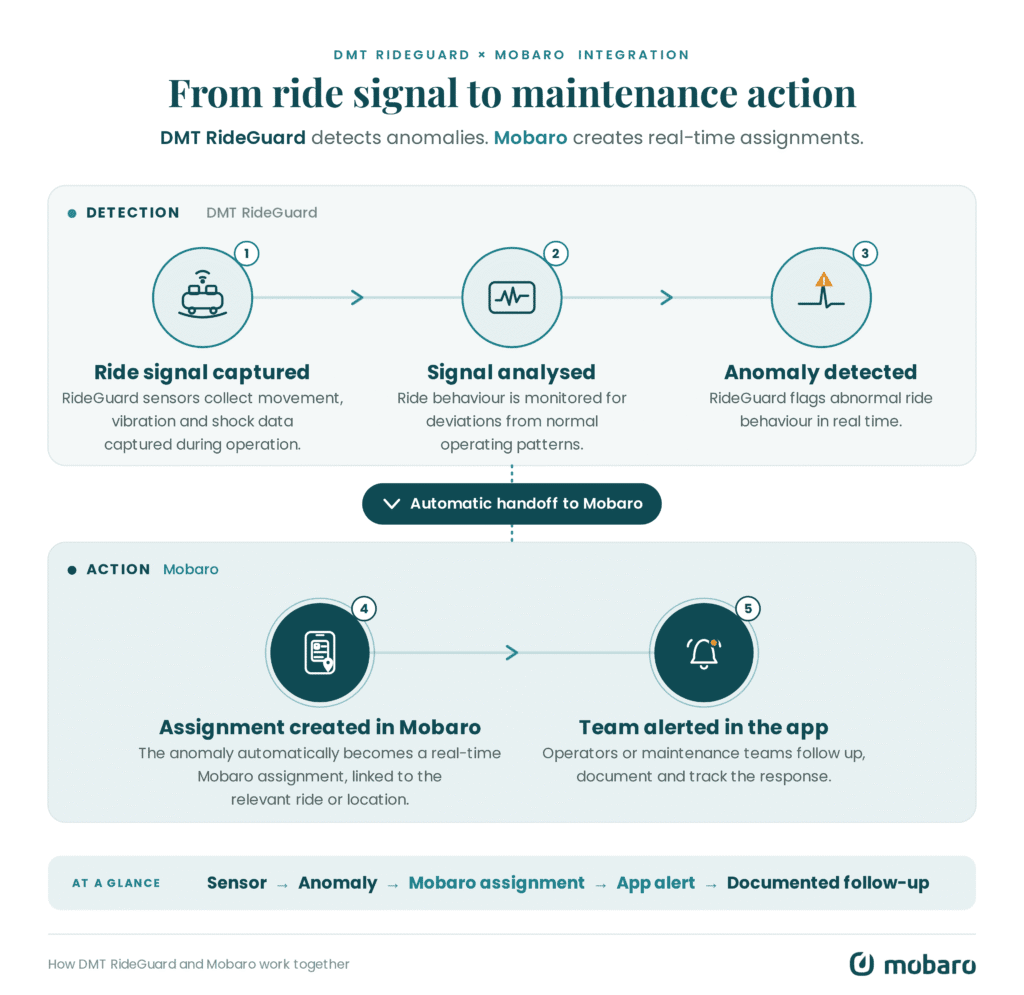
Solutions such as DMT RideGuard can not only collect data but also analyse it and identify trends or deviations that might otherwise be difficult to recognise.
“The purpose of AI is of course not to replace engineers,” Pesgens says, “but to help them identify where attention is needed.“
That principle is just as relevant to inspection as it is to maintenance. The opportunity is not to automate engineering judgement. It is to give that judgement better inputs.
Today, an inspector often starts with a comprehensive understanding of the site: review the structure, assess the safety systems, examine the paperwork, and ensure all details are accurate. Instead of beginning that way, an inspector could increasingly arrive already knowing which parameters have shifted since the previous visit, and spend the time on site investigating that, rather than re-establishing it from scratch. Not a smaller inspection, but a better-informed one.
The missing link is what happened next
Knowing that an anomaly occurred six months ago is not enough. An inspector also needs to understand what followed. Was it investigated? Was maintenance carried out? Was a component replaced? Did the measurement return to its normal range afterwards? Was the corrective action verified?
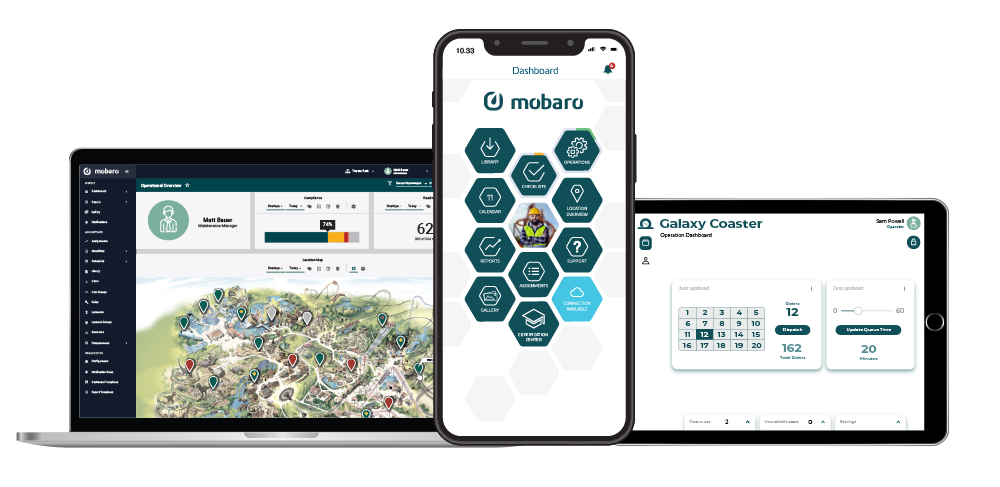
That is where monitoring data needs to connect with the operational systems around it.
“Data should not remain in separate systems or information silos,” Pesgens says.
“By connecting monitoring data and AI analysis with a central platform such as Mobaro, information from operations, maintenance, corrective actions and inspections can become part of one structured technical history.“
This creates an evidence chain. The monitoring system identifies a change. The operational platform records what was done about it. Subsequent measurements show whether the intervention had the intended effect. And the inspector can see the complete history rather than reconstructing it from disconnected systems, spreadsheets and paperwork.
That improves traceability for an operator and gives an independent inspector a much richer basis for verification.
Could inspection itself become more data-driven?
This raises a more provocative question.If reliable operational data can describe what happened to an attraction between inspections, does inspection always need to be organised around the same periodic snapshot?
For now, the answer is clear: continuous monitoring does not replace independent inspection.
“It can actually strengthen it,” Pesgens says.
“For independent inspection companies such as TÜV NORD, reliable historical quantitative data can provide valuable additional context. Instead of only assessing the condition of an attraction at the moment of inspection, an inspector could also understand how certain parameters have developed between inspections.“
Regulatory requirements, physical examination and engineering judgement do not disappear because more data becomes available. But the information available to the inspector is changing.
Over time, that opens the door to a more data-informed approach to inspection: one where historical condition, actual usage, detected anomalies and completed maintenance help determine where engineering attention should be concentrated.
The shift is subtle but important. From: “What condition is the ride in today?” towards “What has happened to this ride since we last saw it?”
From periodic compliance to continuous assurance
None of this removes the boundaries between operator, maintenance team and independent inspector. As Pesgens puts it:
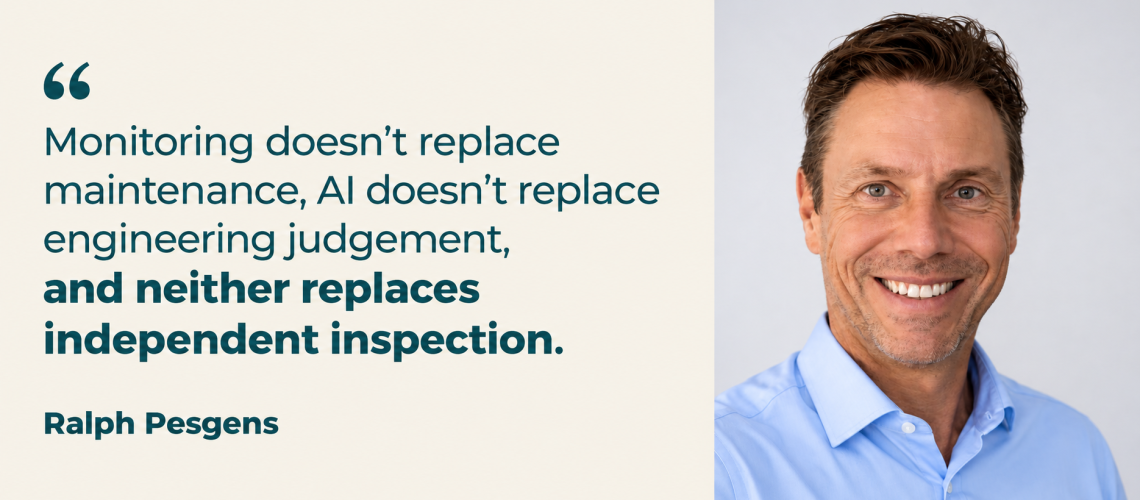
“Monitoring doesn’t replace maintenance, AI doesn’t replace engineering judgement, and neither replaces independent inspection.”
But that may ultimately prove more significant than it sounds.
For most of the industry’s history, inspectors have had to reconstruct what happened between inspections from maintenance records, documentation and the physical condition they find when they arrive. Increasingly, the attraction itself can help provide that history.
The annual or periodic inspection is unlikely to disappear. But the idea that an inspector should only have a snapshot of the ride may. The future of inspection could therefore be less about replacing the inspector and more about giving them something they have never had before:
A reliable technical history of what changed, when it changed, what was done about it – and whether it worked.
That is the real opportunity behind continuous monitoring: inspectors stay firmly in the picture, just with far fewer blind spots to work around.
Verlo en la práctica
Si está explorando cómo el mantenimiento predictivo podría encajar en las operaciones de su parque, o cómo los datos de los sensores podrían conectarse con sus flujos de trabajo de mantenimiento existentes, estaremos encantados de mostrarle cómo se ve eso.
Reservar un recorrido de 30 minutos O contactar
Te mostraremos cómo Mobaro estructura las alertas, las órdenes de trabajo, las inspecciones y la documentación en un solo lugar, y cómo puede funcionar junto con sistemas de sensores como DMT RideGuard.
















 ES
ES  EN
EN